
GTCC’s Students SHINE event puts spotlight on outstanding innovation, dedication and creativity
Published on: July 8, 2026
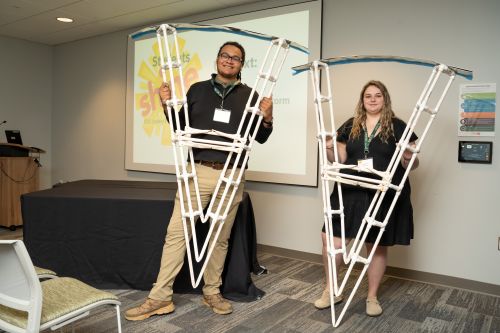
Four Guilford Technical Community College engineering students helped ensure the college’s annual Students SHINE event truly lived up to its name—by bringing a standout, hands-on civil engineering project to a campuswide showcase of student achievement.
Each year GTCC’s Students SHINE highlights the outstanding achievements of students from a wide range of departments and programs across the college and all five campuses. The event is marked by thought-provoking presentations, innovative exhibits, live demonstrations, and performances demonstrating students’ diverse skills and passions.
The four students, Vincent Forkner, Jenna Moore, Micah Poe, and Eduardo Castillo-Cortazar, built a working scale model of the Maeslantkering storm‑surge barrier, one of the Netherlands’ most iconic pieces of civil engineering that protects the low-lying country from rising seas.
Their project, completed for their engineering statics and solid mechanics curriculum, challenged them to choose a mega‑project outside the United States and demonstrate the principles of solid mechanics behind it.
“The project got announced in our class and I immediately started scrolling through projects I had picked,” said Forkner. “I stopped when I saw a picture of the storm-surge barrier and showed it to them (teammates). They said this thing looked super cool; we want to make it.”
Moore said, “When we were told about this project in class, we each came up with an idea of what to build. My idea was the Eiffel Tower, but then Vincent came up with this idea. It was way cooler than anything else, and we decided to build it.”
For Forkner, the choice was rooted in a lifelong fascination with European engineering.
“I’ve always been a fan of European civil engineering. I remember growing up watching French trains going across the countryside on television. I remember watching a documentary on a big Dutch flood,” said Forkner.
That early interest guided the team’s direction — and their commitment.
“My goal was to honor the original engineers the best we could with the time and financial constraints we had,” he said.
The team’s goal was to build a model that didn’t just look like the Maeslantkering but also worked like it.
Meeting two to three times a week and often working four to five hours at a time, they studied the types of stress the real structure must withstand and designed their version to mimic those forces in action. The result— a model that demonstrates how the massive barrier moves, locks, and resists pressure during storm‑surge events.
For the students, the project was more than an assignment — it was a chance to test their skills, collaborate, and present their work to the community.
Moore said the experience helped the group in many ways.
“This is honestly a really big deal,” she said. “It helped us get out there and show off what we built, talk about how we built it. We gained experience in designing models and making presentations.”
Back to All Articles