
Two GTCC graduates land rare roles in cardiovascular operating rooms
Published on: August 3, 2026
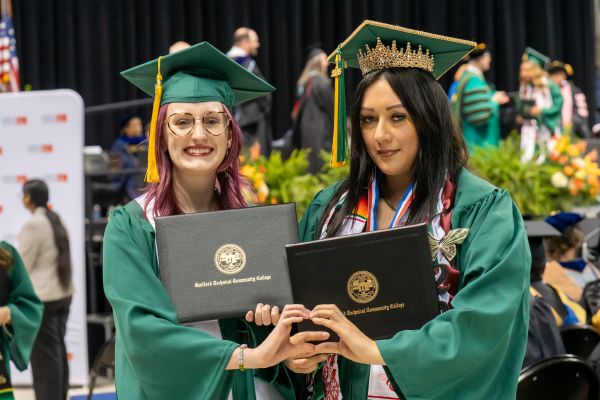
The GTCC surgical technology program recently graduated one of its largest classes ever, with 28 graduates crossing the stage in May 2026. Two of those students, Seira Tulecki and Katie Huss, are headed straight to work in cardiovascular operating rooms at local hospitals.
The goal of GTCC’s surgical technology program is to prepare entry-level surgical technologists with the knowledge, skills, and behaviors needed to assist in the operating room.
Tulecki, 39, works for Cone Health in Greensboro, and Huss, 20, works at Atrium Health’s High Point Regional location.
Because of her father’s job as a cardiovascular surgeon in the U.S. Marines, Tulecki lived in various states before landing in Graham, North Carolina, where she graduated from Graham High School in 2005.
“Since a young age, I always knew I wanted to do something in the medical field,” Tulecki said. “However, I had my first son at 17, so I had to put things on hold for a bit.”
“When I was in the third grade, my dad passed away from a heart attack. Since then, it sparked my curiosity about how the heart works and how to prevent things from happening.”
Huss’ pull toward cardiology was ignited by her love of anatomy and physiology but a health scare for her father, and her own, confirmed her interest.
“My dad had septic shock four years ago, and it nearly killed him. He had heart, kidney, and lung failure,” she recalled. “Later on, as I was taking him to a cardiologist at a follow-up appointment — and that was a few years before my anatomy and physiology class — I really started understanding what happened to my dad.
“I also realized I was having some similar cardiology issues that my dad had experienced before he got sick.”
In 2019, Tulecki was working on finishing her general education classes at GTCC when the pandemic hit, causing a delay in her education and prompting a call from a GTCC adviser.
“Someone from GTCC called me and said they had looked at my transcript and asked why I had stopped coming,” she recalled. “I told them that, with the pandemic, I wasn’t working and had to pause school. They told me about grant funding, scholarships, and other resources available. The adviser asked me what I wanted to do, and I told them about surgical technology.
“They told me that I just needed to take microbiology to qualify for the program. So, I started taking the class and then applied to the surgical technology program while I was still in microbiology and was accepted into the program in the summer of 2024.”
Knowing cardiovascular surgery was her path, Tulecki advocated for herself — with support from GTCC professor John Ratliff and GTCC instructor Maggi Ortiz — to get inside an open-heart operating room as soon as possible.
“They don’t really accept students in the open-heart room very often,” Tulecki said. “I begged the right person and told them I was very interested in hearts and wanted to see what it’s like and how everything works in the heart operating room. The first time I went in, I was taking notes on everything — the setup, drawing pictures, etc. There is a seriousness to any operating room, but when you walk into a heart operating room, it’s like nothing else. It works like a very quiet, well-oiled machine. The first time, I was just in awe. It was a very special moment. It’s a feeling you can’t really describe.
“Mrs. Ortiz told me they really liked me because I took notes and asked questions when appropriate, so they invited me to come back. The first time I scrubbed in, I took everything I had learned from my observation time, and the preceptors were very impressed because they kept asking me to come back.”
Huss started her journey at GTCC in 2023, fresh out of Rockingham County High School. Unlike Tulecki, she wasn’t quite sure what career path she wanted to pursue.
“I did a year of prerequisites for dental hygiene; as soon as I started anatomy and physiology, I realized it’s the coolest thing ever. It is so complicated in the best way,” Huss said. “Dental hygiene was cool, but I wasn’t OK with just specializing on the mouth. I want to see everything in everyone.
“I saw the surgical technology program on the website and wanted to check it out more. I was also a GTCC student ambassador, so I had opportunities to ask different folks around the college about the program.”
After entering the surgical technology program and fulfilling all her required clinical rotations, Huss had the opportunity to witness her first open-heart surgery.
“One day while I was doing clinicals at High Point Regional, I had no cases left and saw there was an open-heart procedure taking place and was able to observe,” Huss recalled. “In the usual operating room, there are maybe four or five people in the stressful area. However, in the heart operating room, there is much more to set up, a larger room, twice the size of a normal operating room, and more staff.
“I had so many questions, and everyone was so great about answering them. You need multiple mentors and mentees to work in cardiovascular surgery. They were all so helpful. I distinctly remember seeing the heart for the first time on the TV screen in the operating room. After that day, my first thought was, ‘When can I come back? Can I come back tomorrow?’ I had so many questions. I took so many notes.”
Once Tulecki learned that Huss had similar cardiovascular surgery career goals, she graciously shared her detailed open-heart surgery notes for Huss to study.
“Seira shared her notes with me, and it was very affirming to have someone with a little more experience validate my goals,” Huss said. “It’s really helpful to see how things are done in different cases. It’s a nice buddy-buddy moment to have with a classmate.”
Entering the program at the same time, Tulecki and Huss both praised the surgical technology program, its professors and classmates, and the supportive environment it fosters.
“We are all supporting each other. I feel like this program is more than classmates,” Tulecki said. “We treat each other like siblings that we don’t want to see fail. Professor John Ratliff and Maggi Ortiz are the same. There were times in the program when I thought I should put this all on hold, and they said, ‘You’re going to suck it up and do it!’ They’ve given me a sense of family.”
“I have nothing but good words for professor Ratliff and Mrs. Ortiz. Not only was I an ambassador for the college, but I was also a work-study student for the surgical technology department,” Huss said. “If you have a question, they will try to answer it, even if it’s a surgery they’ve never worked on before. They’ll call colleagues who have and get you an answer.”
The respect and admiration are mutual for Tulecki and Huss from their GTCC professors, Ratliff and Ortiz.
“Both Seira and Katie faced obstacles that might have caused others to give up, but they chose to persevere,” said John Ratliff, GTCC surgical technology program director. “They pushed forward with determination, resilience, and an unwavering commitment to excellence. They represent the very best of this profession, and I could not be prouder of the two of them.”
“It is absolutely incredible to see them thriving,” said Maggi Ortiz, GTCC surgical technology clinical instructor. “To give you some context on how rare this is: Typically, a surgical tech needs years of experience or must work as a hospital employee and shadow the team extensively before being considered for the cardiovascular operating room. Landing a spot on the open-heart team straight out of school is almost unheard of and speaks to their exceptional talent.”
“In my 23 years of teaching surgical technology, only eight graduates, including Seira and Katie, have gone directly from graduation into the open-heart operating room,” said Ratliff, “That alone speaks to how rare and significant this accomplishment truly is.”
For more information on GTCC’s surgical technology program, visit gtcc.edu/academics/academic-programs/programs/health-and-wellness/surgical-technology.php.
Back to All Articles