
Fire Continuing Education
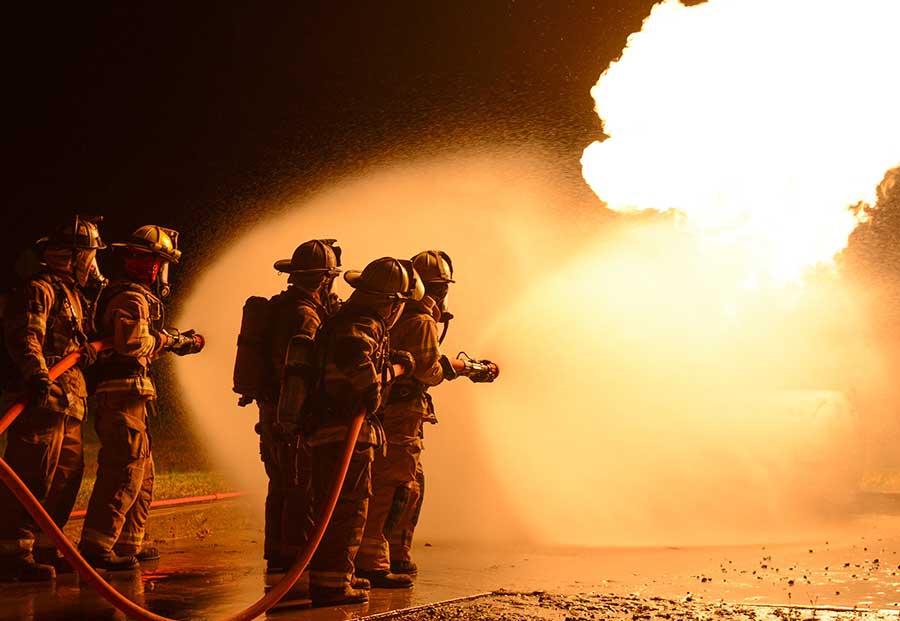
Courses range from North Carolina fire and rescue certification programs to specialized, leadership, technical, and professional development training. Classes are offered at GTCC's Emergency Responder Training Center (ERTC), local fire departments, other training locations, and online.
Located on GTCC's Jamestown Campus, the Emergency Responder Training Center provides realistic training environments and specialized facilities that support classroom, fire, rescue, and hands-on training. Our instructors bring fire and emergency services experience into the classroom and training environment to provide relevant, practical instruction.
Our Goal
To provide safe, professional, realistic, and innovative training to fire and rescue personnel.
This goal directly supports GTCC's commitment to People, Pathways, Partnerships by developing highly skilled fire and rescue professionals, creating educational and career pathways for our students, and working with local fire and rescue agencies to meet the workforce and training needs of the communities we serve.
In addition to traditional Continuing Education courses, GTCC offers 4-Week PROPEL Partner courses that connect workforce training with higher education by allowing firefighters to complete accelerated online courses while earning curriculum credit toward the Fire Protection Technology Associate degree.
Course Schedule Notice
Course dates, times, and locations are subject to change due to enrollment, weather, instructor availability, or other unforeseen circumstances. Students should review the GTCC Fire Training Calendar for the most current course information.
Questions regarding a course may be directed to firetraining@gtcc.edu.
4-Week PROPEL Partner Courses
Turn Your Fire Service Training Into College Credit
GTCC's 4-Week PROPEL Partner courses provide working firefighters with a flexible pathway toward earning an Associate degree in Fire Protection Technology.
These accelerated courses are offered online over approximately four weeks and are designed to work around the schedules of active firefighters. Successful completion provides curriculum credit that can be applied toward GTCC's Fire Protection Technology Associate degree.
GTCC can also review eligible previous fire service certifications, training, and college coursework to determine whether additional curriculum credit can be applied toward the degree.
The goal is to recognize eligible training firefighters have already completed while providing an accessible pathway for continued education and degree completion.
How It Works
- Reserve Your Seat - Select an available 4-Week PROPEL Partner course from the GTCC Fire Training Calendar.
- Complete Registration and Canvas Onboarding - Our Fire Continuing Education Program Coordinator will contact you and walk you through the registration process and getting started in Canvas.
- Complete Your 4-Week Course - Complete the required online coursework during the four-week session.
- Begin Your Degree Pathway - GTCC will work with you on enrollment in the Fire Protection Technology degree program and review eligible NC OSFM certifications and previous college coursework for potential curriculum credit.
- Keep Moving Toward Graduation - Continue completing PROPEL Partner courses and any remaining curriculum or general education requirements needed for your Associate degree.
Plan Your Path to Graduation
Every firefighter's path to a degree may look different based on certifications, previous college coursework, and courses already completed.
The GTCC Fire Protection Technology Degree Planner provides a simple way to see how 4-Week PROPEL Partner courses, eligible fire service certification credit, and remaining general education courses can work together toward completion of the Associate degree.
Students can use the planner to identify courses they have completed, certification credit they may be eligible to receive, and requirements that may remain.
4-Week PROPEL Partner Course FAQs
Reserving a seat lets us know you intend to participate and is the first step in the registration process.
After you reserve your seat, you will be contacted by our Fire Continuing Education Program Coordinator.
The Program Coordinator will walk you through the Continuing Education registration process and Canvas onboarding, including making sure you know how to access your course and are ready to begin when the class opens.
Generally, no. You do not have to be online at specific times unless your instructor schedules time to meet with you.
Students are responsible for keeping up with assignments, deadlines, course announcements, and any scheduled meetings communicated by the instructor.
No. The four-week format provides flexibility for working firefighters, but it does not reduce the course's academic expectations.
Students should be prepared to complete a significant amount of coursework during the four weeks.
No. You can begin by reserving a seat in an available 4-Week PROPEL Partner course.
After registration, GTCC staff will work with you on enrollment in the Fire Protection Technology degree program, so eligible course and transcript credit can be applied toward your degree.
Yes. Several fire service certifications and training programs may qualify for curriculum credit toward GTCC's Fire Protection Technology Associate degree.
GTCC will review your certifications and previous college coursework to determine which credits can be applied toward your individual degree requirements.
Fire Service Certification Credit
|
Fire Service Certification/Training |
Potential Curriculum Credit |
Credits |
|
NC Firefighter I & II (OSFM) |
FIP 120 – Introduction to Fire Protection |
3 |
|
Fire and Life Safety Educator I, II & III (OSFM) |
FIP 124 – Fire Prevention and Public Education |
3 |
|
Certified Fire Investigator (CFI) – IAAI |
FIP 128 – Detection and Investigation |
3 |
|
NC Fire Investigation Technician (FIT) – OSFM |
FIP 128 – Detection and Investigation |
3 |
|
NC Fire Inspector Level I |
FIP 136 – Inspections and Codes |
3 |
|
NC Fire Instructor I & II (OSFM) |
FIP 224 – Fire Instructor I & II |
3 |
|
NC Hazardous Materials Technician Level (OSFM) |
FIP 230 – Chemistry of Hazardous Materials |
5 |
|
Chemistry of Hazardous Materials – Continuing Education |
FIP 230 – Chemistry of Hazardous Materials I |
5 |
|
NC Fire Officer I & II (OSFM) |
FIP 226 – Fire Officer OR FIP 240 – Fire Supervision OR FIP 248 – Fire Service Administration OR FIP 276 – Managing the Fire Service |
3 |
|
NC Driver Operator: Pumps (OSFM) |
FIP 232 – Hydraulics and Water Distribution |
3 |
|
NIMS 100, 200, 300, 400, 700 & 800 – FEMA/NCEM |
EPT 140 – Emergency Management |
3 |
Other fire-related certifications may also be considered for curriculum credit but must be reviewed and approved by appropriate GTCC Staff.
Credit eligibility is based on current GTCC and North Carolina Community College System requirements. Individual student records will be reviewed to determine applicable credit. Additional degree requirements may remain after eligible certification credit is awarded.
Your individual pathway depends on the certifications and college credit you already have.
Before taking every available 4-Week PROPEL Partner course, GTCC will review your eligible certifications and previous college coursework to help identify the courses you actually need.
The goal is to give you credit for eligible training you have already completed and help you focus your time on the courses and degree requirements you still need.
Try Before You Pry – before diving in headfirst with a full course load, we recommend taking one or two classes to get used to the flow.
You may be closer than you think.
The Fire Protection Technology Associate degree requires 64 credit hours. Eligible fire service certifications and previous college coursework may satisfy a significant portion of those requirements.
GTCC requires students to complete at least 25% of the degree requirements at GTCC, as well as at least one-third of the major coursework at GTCC. For the 64-credit-hour Fire Protection Technology degree, at least 16 credit hours must be completed through GTCC.
Your individual pathway will depend on the fire service certifications and college credit you already have. Our staff will review your record, identify eligible credit, and help you determine the courses you still need to complete your degree.
Transfer and Credit for Prior Learning are subject to current GTCC and North Carolina Community College System requirements and individual review.
The 4-Week PROPEL Partner courses allow students to complete all of the major Fire Protection Technology coursework required for the Associate degree. For eligible students, these courses have registration fees waived.
Students must also complete the required general education courses for the degree. General education courses are not part of the 4-Week PROPEL Partner course format, are offered on a different schedule, and are not eligible for the fire service registration fee waiver.
The Fire Protection Technology Degree Planner can help you identify credit you may already have and see how the 4-Week PROPEL Partner courses and remaining general education requirements fit together toward graduation.
If you are a current member of a North Carolina fire or rescue department, the 4-Week PROPEL Partner courses are eligible for the applicable Continuing Education registration fee waiver.
Yes – you can take them for free!
This fee waiver applies only to the 4-Week PROPEL Partner Fire Protection courses.
Required general education courses are not part of the 4-Week PROPEL Partner format and are not covered by the fire service registration fee waiver. Students are responsible for the tuition and fees associated with those courses.
After successful completion, GTCC Fire Continuing Education completes the course closeout process. The necessary completion information is then provided so the corresponding curriculum credit can be processed toward the student's degree.
Helpful Links
Frequently Asked Questions
View the GTCC Fire Training Calendar, select the course you would like to attend, choose Reserve Seat, and complete the required registration process.
Financial aid is not available for continuing education courses.
Required equipment varies by course. Students participating in courses requiring structural firefighting PPE should plan to provide appropriate turnout gear and SCBA unless otherwise stated in the individual course information.
Students should review the course listing for specific equipment, textbook, PPE, or other requirements.
Fire Continuing Education provides certification, advanced training, professional development, and specialized courses for current and prospective fire and rescue personnel.
The GTCC Fire Academy is an intensive recruit program designed primarily for individuals seeking their initial firefighter, rescue, and hazardous materials certifications and preparing to enter the fire service.
For current Academy dates, requirements, and application information, visit the Fire Academy webpage.
Eligibility for students under age 18 depends on the student's age, course, fire department affiliation, applicable certification requirements, and current state regulations.
Please contact GTCC Fire Continuing Education before registering so we can determine eligibility for the specific course.
Visit the NC OSFM certification/transcript portal to view your current certification record.
Please allow up to 90 days following completion of a certification course for the course to appear on your NC OSFM transcript.
If the course has not appeared after 90 days, contact Fire Continuing Education at firetraining@gtcc.edu.
Contact Fire Continuing Education at firetraining@gtcc.edu and provide:
- Full name
- Date of birth
- Course name
- Approximate course date(s)
- Valid phone number – We will reach out to you to get your OSFM 4-digit requirement
View the GTCC Fire Training Calendar for upcoming certification, specialty, online, and 4-Week PROPEL Partner courses.
VIEW FIRE TRAINING CALENDARYes. If all classes at GTCC are canceled due to inclement weather, then all con/ed classes conducted away from campus are canceled also.