
Schedule of Reduction (SOR) Examples
Beginning with the 2026–2027 award year, federal regulations require schools to adjust annual federal loan eligibility for students who are enrolled less than full-time during the academic year. The examples below illustrate how the Schedule of Reduction (SOR) may affect undergraduate borrowers at GTCC.
Example 1: No Adjustment Needed
Scenario: The student is enrolled full-time throughout the academic year and meets the required annual enrollment threshold.
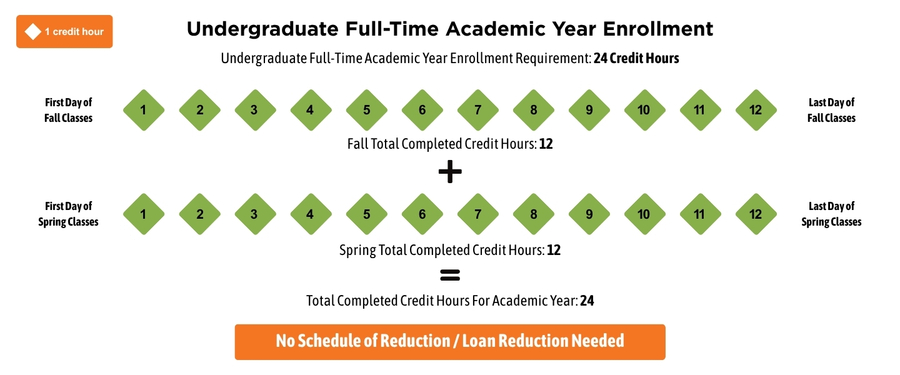
Result: No loan reduction is necessary because the student satisfies the full-time academic year requirement.
Why?
- Enrolled at least 12 credit hours each semester.
- Meets the 24-credit-hour academic year requirement.
- Remains eligible for the full annual federal loan amount.
Example 2: Loan Reduction Needed
Scenario: The student never reaches full-time enrollment during the academic year or is reported as less than 12 credit hours at the census date for the fall term.
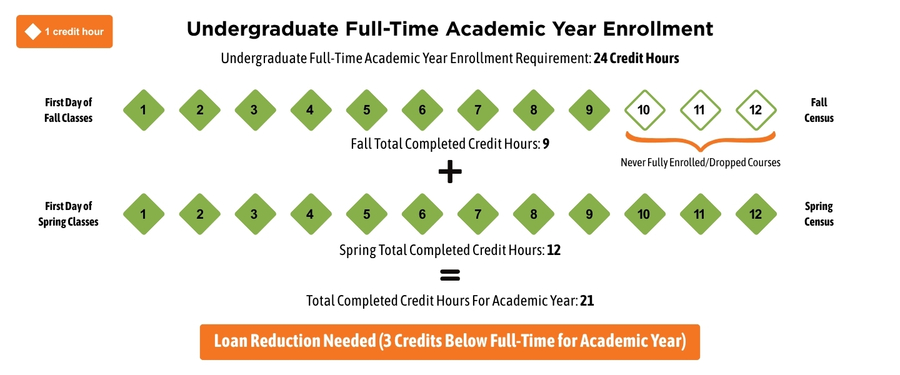
Result: A Schedule of Reduction calculation is required, and the student's federal loan eligibility must be reduced.
Why?
- The student does not meet the full-time academic year enrollment requirement.
- Federal regulations require annual loan limits to be prorated based on actual enrollment.
Example 3: No Reduction Needed
Scenario: The student was not enrolled full-time during the fall semester but increased enrollment by the spring census date and ultimately met the annual full-time enrollment requirement.
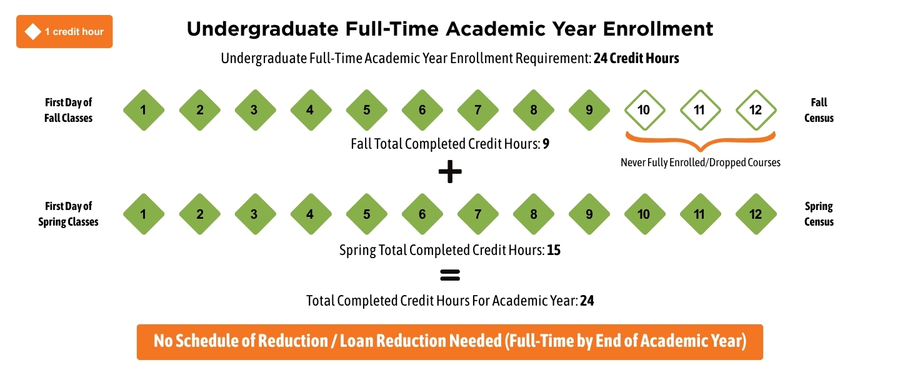
Result: No loan reduction is necessary.
Why?
- Although the student was initially below full-time enrollment, they accumulated enough credits during the academic year to satisfy the full-time requirement.
- Annual enrollment remains eligible for the full federal loan amount.
Example 4: Loan Reduction Needed Before Disbursement
Scenario: Before fall financial aid disbursed, GTCC determined that the student would not meet full-time enrollment requirements for the academic year.
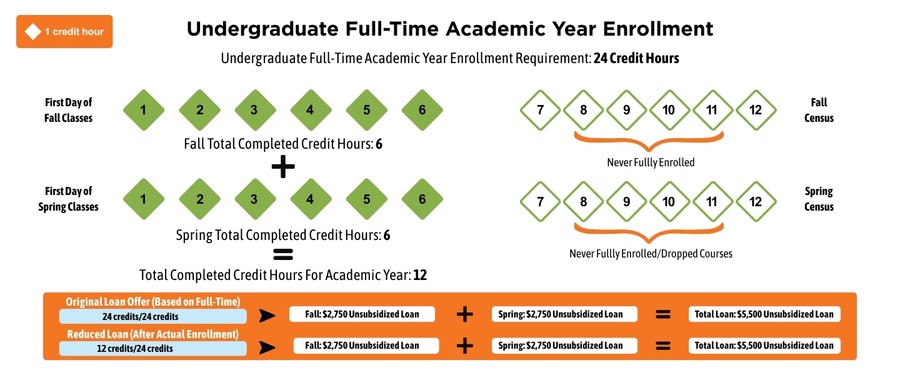
Result: The Schedule of Reduction was calculated before any loan funds were released.
Why?
- The student's enrollment plans were known prior to disbursement.
- Federal loan eligibility was adjusted based on expected enrollment.
- The remaining annual loan eligibility was divided appropriately between the eligible terms.
Student Impact
- Reduced annual loan eligibility.
- Loan funds distributed according to the adjusted award amount.
Example 5: Loan Reduction Needed After Fall Disbursement
Scenario: The student received the fall portion of their federal loan and later dropped courses, reducing their fall enrollment.
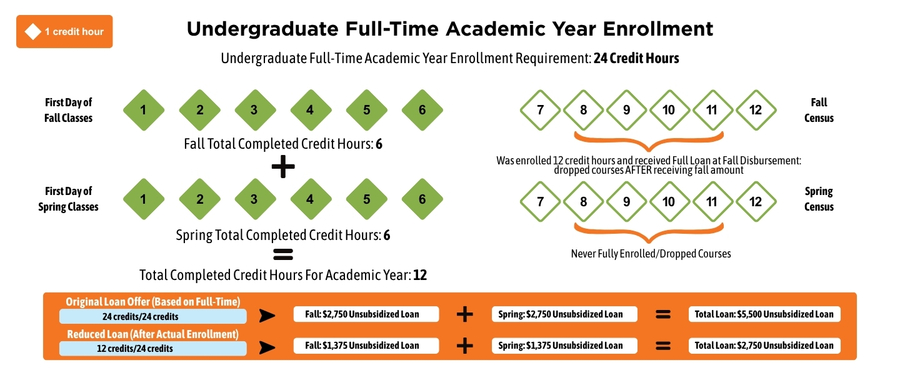
Why?
- The student's enrollment no longer supported the original annual loan eligibility.
- Because the student had already received their fall loan funds, the adjusted calculation may leave no remaining eligibility for spring.
Student Impact
- Spring federal loan eligibility may be reduced or eliminated.
- Future disbursements are based on the recalculated annual loan amount.
Need Assistance?
GTCC Financial Aid Office
finaid@gtcc.edu
336-334-4822, Ext. 50000
Information on this page is based on current federal legislation and guidance available as of July 2026 and is subject to change pending additional U.S. Department of Education regulations or interpretations.